VISIGOTHIC, MOZARABIC OR OLD HISPANIC RITE?
⌅From the sixth century onwards, when we have the first traces of liturgical practice, a distinct rite was celebrated in the churches of the Peninsula, including the areas that would later become al-Andalus.6On the antiquity of the rite see Levy 1993; Randel 1993; and Gonzálvez Ruiz 1998. See also Hornby et al. 2022; and Hornby and Maloy 2013. The rite is often referred to either as Visigothic or Mozarabic (and in Spanish, sometimes as ‘Hispano-visigótico’ or ‘Hispano-mozárabe’), both of which are misleading terms. There is some justification for calling the rite ‘Visigothic,’ since a certain substratum was likely in place by the end of the seventh century. The Visigothic councils of the sixth and seventh centuries give us a sense that some liturgical elements were shared across the Peninsula, and we even have a manuscript that attests to parts of the liturgy as performed before the Arab conquests: the early-eighth-century Liber orationum festivum found presently in Verona (hence Verona Orational).7Verona, Biblioteca Capitolare MS LXXXIX (see manuscript table below for full details), on which see Díaz y Díaz 1997; and Vivancos 2006. For a survey of the council decrees, see Arocena 2017; and Lester 2017. The tendency to attribute many of the rite’s texts to major theological writers of the Visigothic period—Leander and Isidore of Seville, Ildefonsus of Toledo, Eugenius II of Toledo, Braulio of Zaragoza, Julian of Toledo—nevertheless exaggerates their contribution to what was the product of centuries of development and involved many anonymous composers and authors.8A recent example of this is Ferrer Grenesche 2018, 70-71. These attributions are generally found in the De virus illustribus, a series of episcopal biographies with a strongly hagiographical character (and found in a southern manuscript: El Escorial, Biblioteca del Real Monasterio MS. &.I.14), on which see Ihnat 2022, 11; and Pinell 1998, 46. Most of the liturgical manuscripts date to the tenth and eleventh centuries meaning that, even with signs of continuity from earlier periods, the term ‘Visigothic’ remains inaccurate given the chronological distribution of the evidence.9Arguing for continuity is Randel 2019. For an analysis of continuity in terms of saints’ liturgies, see Jones 2023, chap. 2.
Equally problematic is the term ‘Mozarabic’ used to describe the rite and the chant with which it was transmitted.10See most recently Fernández de la Cuesta 2013; Ivorra 2017; Asensio Palacios 2018; but going back to Férotin 1912 (and earlier); and also, the foundational Randel 1973. If we consider Mozarabs to be Arabicized Christians, whether in linguistic or cultural terms, defining the rite as ‘Mozarabic’ calls to mind a close association with Andalusi Christians. The sources normally described as representing the rite are almost entirely found in manuscripts from the Christian-ruled kingdoms of Asturias-León and Navarre, however.11A series of manuscripts from Toledo are an exception, which will be discussed below. Although these sources might bear traces of influence from Andalusi monks who established themselves in northern areas, it would be difficult to conclude that the rite itself is ‘Mozarabic’, which in any case is a term that first appears in the eleventh century.12The term refers to Christians operating in Arabic in the Latin north, on which see Aillet 2010; Aillet, Penelas and Roisse 2008; Christys 2002; Hitchcock 2008; and Fernández Conde 2009. As a result, scholars generally now refer to the rite celebrated on the Peninsula in the Early Middle Ages with the adjective ‘Old Hispanic’.13Starting with Randel 1969, but followed by Hornby and Maloy 2013; and Hornby et al. 2022. Rojo Carrillo 2021 refers to the Hispanic rite, the Spanish equivalent of which (“liturgia hispánica”) is witnessed by Pinell 1998. We have only about forty manuscripts surviving that correspond to this rite. All of these, bar one, are from the Christian kingdoms, which includes Toledo after 1085. And almost all of them, except a group from Toledo (discussed below), were produced before ca. 1080, at which point the rite was officially replaced with the Roman rite under the orders of Alfonso VI.14For an introduction to the rite, its history, structures and components, see Hornby et al. 2022; Rojo Carrillo 2021; Hornby and Maloy 2013; and Pinell 1998. Even accounting for diversity of repertoire in different regions and institutions, there are enough similarities in book type, liturgical structures and genres between the extant liturgical manuscripts that the Old Hispanic rite can be said to exist as a distinct liturgical tradition.
LITURGICAL MANUSCRIPTS
⌅Was the Old Hispanic rite as we know it from northern manuscripts celebrated the same way in al-Andalus? The problem in answering this question is the paucity of liturgical manuscripts known to have been produced in al-Andalus. As stated above, only one complete manuscript of a liturgical character is clearly associated with the Andalusi sphere (CEA, which we discuss below); the rest are fragmentary and of uncertain origin. Understanding the liturgy of al-Andalus has therefore relied on the sixteenth-century attempts to reconstruct it by Francisco Ximénez de Cisneros and Alfonso Ortiz. Their efforts led to the creation of the Neo-Mozarabic liturgy still performed at the Mozarabic chapel in Toledo Cathedral.15For the later reconstructions of this rite, see especially Boynton 2011. An example of a recent study that makes use of these sources is that of Adolfo Ivorra which, although it recognizes the various phases of the rite’s development, includes them all together in the general analysis as if they all represented one rite.16Ivorra 2017. We should be wary of taking this later reconstruction as a true reflection of the medieval rite, however, given that it was changed and supplemented in many places. Here we consider only the surviving manuscripts and not editions produced in the sixteenth century and onwards.17See for a useful evaluation Rojo Carrillo 2018, 99-107.Table 1 provides a list of these manuscripts and the sigla to which we shall refer in what follows.
Table 1 Manuscripts (liturgical and other) mentioned in this article
| Sigla | Shelfmark | Type | Date | Provenance |
|---|
| BL45 | London, British Library Add. MS. 30845. Díaz y Díaz 1995, 143-144; Hornby et al. 2022, xix | Liber misticus (post-Pentecost time) | 10th c. in. | San Millan de la Cogolla |
| BN01 | Madrid, Biblioteca Nacional de España Cod. 10001. Mundó 1965, 14, 20; Hornby et al. 2022, xx | Psalterium, canticorum, hymnorum; fragmentary liber misticus (fly leaves) | 12th c; 11th c. med. | Santa Eulalia (Toledo) |
| BN10 | Madrid, Biblioteca Nacional de España Cod. 10110 | Liber misticus (Lent) | 1250/1300 | Santa Justa y Rufina |
| BN29 | Madrid, Biblioteca nacional de España Cod. 10029 (Azagra) | Hymns for various saints (unnotated); notated poems | 10th c. | Córdoba? |
| BN56 | Madrid, Biblioteca Nacional de España Cod. 11556 | Antiphonal fragment (flyleaf) of a 12th century manuscript) | 11th c. | San Zoilo de Carrión (or perhaps San Zoilo de Córdoba) |
| BU31 | Madrid, Biblioteca de la Universidad Complutense Cod. 31 | Bible with marginal liturgical markings | 9/10th c. | Toledo? |
| CEA | Munich, Bayerische Staatsbibliothek Cod. Aumer 238 | Evangeliary incipits in Arabic and Arabic Gospels | 14th c. | Seville? |
| Cinc | Cincinnati, Klau Library of the Hebrew Union College, Acc. no. 434 | Fragmentary liber misticus | ca. 1200 | Santa Eulalia (Toledo)? |
| COIM | Coimbra, Archivio da Universidade, IV-3.a–Gav. 44 (22) | Fragment of antiphoner | c. 1000 | Toledo? |
| Esc941 | El Escorial, RBME 941 | | Before 1206? | Córdoba |
| EscP.I.6 | El Escorial, P.I.6 | Fragmentary liber orationale or liber horarum (palimpsest) | 12th c. ex. | Toledo (orig. Córdoba?) |
| EscR.II.18 | El Escorial, R.II.18 | Book list (includes Liber Antiphonarium maiore, Liber Ordinum, Liber Antiphonarium ex cotidianis, Libros storiae aeglesiasticae apud an…, Liber Martirologium romense apud) | 9th c. ex. | Córdoba? |
| F17 | Florence, Biblioteca Laurenziana, Ashburnham 17 | Ildefonsus, De virginitate Sanctae Mariae (divided into liturgical lessons) | 1067 | Santa María de Alficen (Toledo) |
| L8 | León, Biblioteca de la Catedral Cod. 8 | Liber antiphonarium | 10th c. med. | León (Southern model?) |
| MSC25 | Toledo, Museo de Santa Cruz MS 1325-1 (this manuscript is presently on loan to the Museo de los Concilios y de la Cultura Visigoda, Toledo) | Fragmentary Liber misticus (4 saints’ feasts: John the Baptist, Peter and Paul, Simon and Jude, Martin) | 13th c. | Santa Leocadia y San Román; Santas Justa y Rufina (Toledo) |
| MSC26 | Toledo, Museo de Santa Cruz MS. 1326 | Fragmentary liber commicus or liber evangeliarium | 12th c. med. | Santa Justa y Rufina (Toledo) |
| T3 | Toledo, Archivo y Biblioteca Capitulares de la Catedral Cod. 33.3 | Liber horarum | ca. 1200 | Santa Eulalia (Toledo)? |
| T53 | Toledo, Archivo y Biblioteca Capitulares de la Catedral Cod. 35.3 | Manuale | 11/12th c. | Santa Eulalia (Toledo) |
| T4 | Toledo, Archivo y Biblioteca Capitulares de la Catedral Cod. 35.4 | Liber misticus (Eastertide and quotidian Sundays); fragmentary liber commicus de quotidiano, de infirmis (fly leaves) | 1198-1208; 11th c. ex. | Santa Eulalia (Toledo) |
| T5 | Toledo, Archivo y Biblioteca Capitulares de la Catedral Cod. 35.5 | Liber misticus (Lent and Easter week) | 13th c. med. | ? |
| T6 | Toledo, Archivo y Biblioteca Capitulares de la Catedral Cod. 35.6 | Liber misticus (from Easter week to an incomplete celebration for Saints Justus and Pastor) | 10th c. ex./11th c. in. | ? |
| T7 | Toledo, Archivo y Biblioteca Capitulares de la Catedral Cod. 35.7 | Liber misticus (from the Virgin Mary to the Apparition) | 11/12th c. | Santa Eulalia (Toledo) |
| T8 | Toledo, Archivo y Biblioteca Capitulares de la Catedral Cod. 35.8 | Liber commicus | 12th c. med. | Santa Eulalia (Toledo)? |
| T44 | Toledo, Archivo y Biblioteca Capitulares de la Catedral Cod. 44.2 | Fragmentary Antiphonarium (fly leaves) | 12th c. in. | ? |
| T99 | Toledo, Archivo y Biblioteca Capitulares de la Catedral Cod. 99.30 | Fragmentary manuale (palimpsest) | 12th c. ex. | ? |
| Cordoban Calendar manuscripts |
| Sigla | Shelfmark | Language | Date | Provenance |
| CCA | Paris, Bibliothèque nationale de France Hébreu 1082 (ff. 11v-30v) | Judeo-Arabic | 14th c. | Huesca |
| CCL | Paris, Bibliothèque nationale de France MS Latin 9335 (ff. 151v-160v) | Latin | 13th c. in. | Venice / Padua |
| P2521 | Paris, Bibliothèque nationale de France MS Arabe 2521 (ff. 129r-135v) | Arabic | 16th c. | Damascus? |
| Risala | Rabat, Khizanat al-hasaniyya 6699 (1-49 – pagination, no foliation) | Arabic | 16th c.? | Maghreb |
| KA | Tehran, Kitābḫāna-yi Millī-yi Malik 2049 (1-71 – pagination, no foliation) | Arabic | 15th c.? | Middle East |
| Balad.2918 | Alexandria, al-maktaba al-baladiya 2918 (ff. 25-50) | Arabic | 1822 | Maghreb |
| Vic167 | Vic, Museo Episcopal de Vich 167 (ff. 1r-8r) | Latin | 1235 | Ripoll, Catalonia |
| BN6036 | Madrid, Biblioteca nacional de Madrid Cod. 6036. Foliation unknown. | Latin | 14th c.? | Catalonia |
| Lat.qu.198 | Berlin, Staatsbibliothek Berlin Lat.qu.198 (ff. 135v-143v) | Latin | c. 1132 | Moissac? |
| PA45 | Lyon, Bibliohèque Municipal de Lyon, PA 45 (ff. 130v-142r) | Latin | 12th c. | Catalonia / Angers? |
| ÖNB2462 | Vienna, Österreichische Nationalbibliothek 2462 (ff. 27r-72v) | Latin | 12th c. | Catalonia? |
| Reg.lat.596 | Vatican City, Biblioteca Apostolica Vaticana, Reg.lat.596 (ff. 36r-45v) | Latin | 12th c. | Fleury Abbey |
| T4624 | Tunis, Bibliotheque Nationale de Tunésie, 4624 | Arabic | 1910 | Tunisia? |
| Vat.ar.258 | Vatican City, Biblioteca Apostolica Vaticana, Vat.ar.258 | Arabic | 16th c.? | Maghreb |
| D2197 | Rabat, Bibliothèque Nationale du Royaume du Maroc (BNRM) D2197 (p. 75-152: no foliation) | Arabic | 16th c.? | Maghreb |
| K155 | Rabat, Bibliothèque Nationale du Royaume du Maroc (BNRM) K155 (p. 290-344: no foliation) | Arabic | 16th c.? | Maghreb |
| KH10354 | Rabat, Khizanat al-Hassaniyya 10354 (18 ff.: no foliation) | Arabic | 1762 | Maghreb |
| Sbihi163/9 | Salé, Bibliothèque Sbihi 163/9 (ff. 1-94; incorrect foliation) | Arabic | 16th c.? | Maghreb |
| D18945 | Damascus, Al-Assad National Library 18945 (ff. 1-36) | Arabic | 1617 | Damascus? |
Fragments and traces in southern and northern manuscripts
⌅Many of the Latin manuscripts thought to come from al-Andalus were surveyed by Manuel Díaz y Díaz, who carefully cataloged them in an important study.18Díaz y Díaz 1995. The liturgical examples among them are largely fragmentary and contain only isolated liturgical texts or materials related to liturgical practice. One example is a book list (ESCR.II.18) that includes antiphoners, prayer books and a martyrology. Díaz y Díaz argued that the list came from Córdoba and reflects the types of liturgical books that would have been available in religious institutions, although he thinks they ended up in a private library.19Including a liber antiphonarum maiore, liber antiphonarium ex cotidianis, and liber ordinum. Díaz y Díaz 1995, 176-179, edited in CCCM 65B, 1207-08. For similar book provision in the North, especially as seen in charters, see Davies 2016; and Barrett 2023. One of the books in this list has since been identified as the Azagra codex (BN29), a tenth-century compilation of poetry partly copied in al-Andalus.20Farmhouse Albert 2005, 89; 2014; Díaz y Díaz 1995, 130-134; and Zapke 2011, 96-97. In future research, Melanie Shaffer will undertake a complete study of the notation in this manuscript. It features a number of hymns, including one for John the Baptist by Cyprian, a ninth-century archpriest of Córdoba.21Edited by Gil 2020 (henceforth: CCCM 65A and CCCM 65B): CCCM 65A, 701-704. Another more recently-discovered fragment (Coimbra) from an eleventh-century liber misticus has been considered a product of Toledo before the conquest of the city by Alfonso VI in 1085, because of the type of musical notation it features (see below).22Ferreira 1993, 457-459; Zapke 2011, 95-96; 2007, 312-313. The marginal markings in Bibles identified as ‘southern’, such as BU31, indicate their division for liturgical readings, although palaeographical study would be necessary to establish when this marginalia was added.23Just one example (on f. 19r) is the marginal note “Va Feria ad VI in secunda ebdomada” (on Thursday at Sext in the second week [of Lent]) next to Ex. 17:1. The text matches what is found for the same feast in the liber commicus (book of mass readings) Toledo, Biblioteca de la Catedral Cod. 35-8, associated with Toledo (ed. Pérez de Urbel and Ruiz-Zorrilla 1950, 181-182). On BU31 see López Fonseca and Torres Santo Domingo 2019, 173-181. In general, more thorough criteria for determining southern provenance that goes beyond palaeography–of both text and music–is necessary to more firmly place these manuscripts in al-Andalus, since many of the features long defined as ‘southern’ have been identified in northern sources.24See Jones 2023 and Wride 2023, which challenge Díaz y Díaz 1995, 183-187; Rodríguez Díaz 2011; and Camino Martínez 2012.
Another attempt to assess the Andalusi liturgical tradition has been done through analysis of northern manuscripts thought to have been copied from southern models, but this approach must also be revisited. An important example is L8, the mid-tenth-century richly notated and illuminated antiphoner (chant book) from the León region, and one of the most complete sources for the Old Hispanic musical tradition.25The literature on this manuscript is vast, for which see Hornby et al. 2022, xxiii; Zapke 2011, 252-53; with the most recent update on dating and provenance being Gutiérrez González 2020; and Deswarte 2024. With thanks to Thomas Deswarte for sharing an (at the moment) unpublished version of this article. Certain features in this manuscript have suggested that it had a southern model, including the obits of southern bishops in the calendar and liturgical material that would only have been relevant in Toledo, e.g. a procession to the tomb of Leocadia, located in Toledo.26Brou 1954; Pérez de Urbel 1954, 1968; Díaz y Díaz 1983, 308-309; 1995, 124. But although isolated rituals may have been reproduced in L8, this does not mean the entire manuscript was copied from a southern model.27Ihnat 2023. The tenth-century liber misticus BL45 from San Millan de la Cogolla is likewise thought by some to have been based on a southern model, due to the presence of liturgies for saints from Andalusi centres (e.g. Pelagius and Zoylus, both saints linked to Córdoba).28BL45 has been convincingly dated and placed by Jones 2023 (against a competing Silos attribution by earlier authors), and the southern influence raised especially by Díaz y Díaz 1996; 1995, 143-144; and 1983, 403-404. A liber misticus is a manuscript containing office and mass chants, prayers and readings, somewhat like a breviary. Since these saints only receive proper (unique) masses and hymns in BL45 and not proper offices, the idea of a southern model can only go so far. We might expect that such important saints would have been celebrated with proper offices in Córdoba, leading us to wonder if the isolated and partial materials in BL45 could have been copied from a Cordoban model.29Isolated materials may have been found in a manuale and hymnorum (books that contain mass prayers and hymns, respectively) or in partial libelli containing the (in)complete materials for a saint, as found in BnF239 for Saint Pelagius, on which see Ihnat 2024. Although Pelagius’ passio reports the presence of his relics there until 967, Pelagius may never have been celebrated in Córdoba, and his passio (along with his liturgy) could be a northern creation: Christys 2002, 89-93. See further Jones 2023, chap. 2, and Shaffer 2024. A final example, BN56, is a one-folio fragment of an antiphoner from San Zoilo de Carrión in Plasencia, which some think would have been modeled on an exemplar from San Zoilo in Córdoba, but based only on the fact that the monks of Plasencia are thought to have come from Córdoba.30Originally put forward by Brou 1955 as a possibility, but repeated as fact by Randel 1969, 95 and Zapke 2011, 95. As this last example shows, such southern attributions are influenced by the idea—possibly legendary, in some cases—that many monasteries in the northern kingdoms welcomed monks from the south throughout the tenth and eleventh centuries.31Díaz y Díaz 1995, 145; Walker 2016, 182. See also more generally on manuscript circulation Díaz y Díaz 1969a and 1969b. Art historians have also been conflicted on the ‘southern symptoms’ found in illuminations, for which see Walker 1998, 115-116, vs. Silva y Verástegui 2003. We must be wary, however, of extrapolating too much on the supposed ‘southern elements’ of northern manuscripts.
The Toledan manuscripts
⌅A series of manuscripts associated with the former Visigothic capital of Toledo has been treated as an important source for understanding the liturgical rite practiced in al-Andalus, but once again, in ways that have recently undergone reassessment. The Toledan manuscripts have been linked to that city in part because they were kept there (largely in the Cathedral Library – see Table 1), and in part because they share certain palaeographical features and mostly use ‘horizontal notation’, a type of musical script different from the so-called ‘vertical notation’ found in manuscripts from León and Navarre (Figs. 1 and 2).32Randel 1969, 80; Hornby and Maloy 2016a, 38; Zapke 2011; Hornby et al. 2022, 178-236. Exceptions include BN01 and T6, which feature vertical notation. See most recently Wride 2023. The production of the codices is also distinctively Visigothic/archaizing, typical of southern manuscripts, cf. Rodríguez Díaz 2011, 96. Originally thought to have been produced between the ninth and eleventh centuries, the Toledan manuscripts were re-dated by Anscari Mundó to the eleventh through fourteenth centuries. 33Mundó 1965. This challenged the former understanding that the manuscripts were witnesses to the rite as practiced in the city under Islamic rule. They are now thought to reflect practice at several parish churches in Toledo, the make-up of whose congregations is unclear. Originally thought to have been populated by native Toledan Christians who were permitted to continue practicing their rite when the rest of the kingdom changed to the Franco-Roman tradition, the six ‘Mozarabic parishes’ are now claimed to have been founded in the mid-twelfth century by Christian refugees fleeing persecution from the Almoravids and Almohads, who established their domain over the south of the peninsula. There is no evidence of the existence of these parishes prior to 1156.34Moreno 2012, 148-171; Gros i Pujol 2011. On the supposed dispensations, see García-Gallo 1975; and Gonzálvez Ruiz 1990. If this is true, the Toledan manuscripts associated with the Mozarabic parishes could be seen as transmitting the form of rite that was practiced in the southern-most part of the Iberian Peninsula, and which may have continued to be practiced in those areas as long as they remained under Muslim rule.
There are reasons to wonder if the Toledo manuscripts reflect the rite brought by Andalusis who settled in Toledo, however, and if so, in what ways. These manuscripts bear witness to two different versions of the Old Hispanic rite: Traditions A and B. The basis for the distinction is found in differences in notation (musical script), chant melodies, the structure of the liturgical day, the name given to particular genres of chant and prayer, and the choice of texts for any given feast day.35Differences between Traditions A and B in responsorial tones were noted by Randel 1969, and differences in cadences by Hornby and Maloy 2016a. The first chant of vespers is called a lucernarium in Tradition B and vespertinus in Tradition A as studied by Rojo Carrillo 2021, 79-80. The texts (chants and readings) used for Lent also vary between the two traditions, as explored by Hornby and Maloy 2013, 24-73. See also Maloy 2020, 227-239, on melodic differences; and Wride 2023, 208-215, on notational differences. Both traditions are present in manuscripts associated with Toledo, which has led to debate about what each tradition represents. For some, Tradition A reflects the practice of Christians in the northern kingdoms of the Peninsula and also Toledo itself, which continued at parishes such as Santa Eulalia, where several of these manuscripts were kept. The few Tradition B manuscripts that survive, and which are linked to the parish church of Santas Justa and Rufina, would be a parallel tradition that was brought to Toledo after the twelfth century by Andalusi refugees, particularly from Bética.36Hornby and Maloy 2013; Moreno 2012; Pinell 1978. Other scholars see Tradition B as a later evolution of Tradition A, since the Toledan Tradition A manuscripts date largely to the eleventh to thirteenth centuries whereas the Tradition B manuscripts are from the thirteenth and fourteenth centuries.37Rojo Carrillo 2018; Janini 1977. Challenging this last theory, the discovery of a different notational system in Tradition B manuscripts suggests that it did not just ‘evolve’ out of Tradition A.38Wride 2023. Using notational ‘style’ as Mundó did to date manuscripts is therefore not possible, calling into question his dating of Tradition B manuscripts. Whether Tradition B is a southern Andalusi tradition and Tradition A is from Toledo is difficult to determine due to the scarcity and fragmentary nature of the manuscript sources.39The Tradition B manuscripts contain only a handful of feast days together with the season of Lent: a small fraction of the liturgical year. But if so, it would suggest that there were different variations of the Old Hispanic rite celebrated within al-Andalus itself. Table 2 includes a summary of the possible explanations for the differences we see between this small cluster of manuscripts. Further close palaeographical analysis of both text and notation will surely allow a better understanding of the relationship between the manuscripts, their liturgical contents and whose practice they might represent.40An important study to tackle this question is the doctoral thesis of David Santana, which was submitted too late for it to be considered in detail here.
Table 2 Summary of possible explanations for the Tradition A vs. Tradition B distinction among the Toledan manuscripts
| Tradition A (mostly linked to the Mozarabic parish of Santa Eulalia) | Tradition B (linked to the Mozarabic parish of Santas Justa and Rufina) |
|---|
| Option 1 | Indigenous to Toledo under Muslim rule and shared with Christian north Continued in Mozarabic parishes by native Toledans | Indigenous to Bética Introduced to Toledo in the mid-twelfth century by southern refugees |
| Option 2 | Introduced/influenced by northern Christians after the Castilian conquest of Toledo (1085) | Indigenous to all of al-Andalus |
| Option 3 | Indigenous to much of the Peninsula until the late eleventh century Continued in Mozarabic parishes until the thirteenth century | Evolved out of Tradition A in the thirteenth/fourteenth centuries |
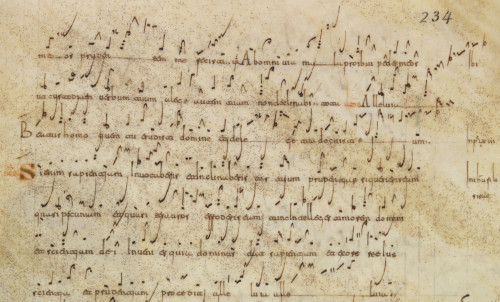
Figure 1 L8: Vertical notation (Tradition A) Source: Archivo de la Catedral de León Cod. 8, f. 234r
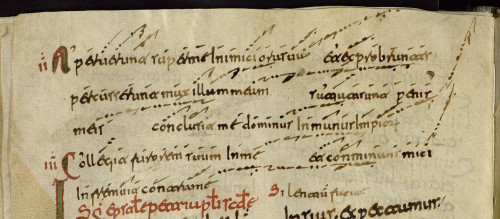
Figure 2 T5: Horizontal notation (Tradition B) Source: Biblioteca de la Catedral de Toledo Cod. 35.5, f. 83v
CEA: The Capitulare Evangeliorum Arabicum
⌅One potential key to unraveling the Tradition A vs. B puzzle is CEA, an Arabic translation of the Gospels followed by a list on ff. 92r-95v that designates which part of the Gospels was read on each of a series of feast days (capitulare evangeliorum). The importance of this manuscript lies in the fact that it is the only surviving liturgical book that has been clearly linked to al-Andalus and it is in Arabic, an aspect to which we return below. The Gospel reading was one of three Biblical readings in the Old Hispanic mass, the other two being from the Old Testament and from the Pauline Epistles.41For a survey of mass contents, see Martín Pindado 1977; Pinell 1998, 154-155. CEA provides for these mass readings by listing, in the order of the liturgical calendar, the chapters that should be used, starting with the Sundays in Advent through to the Quotidian Sundays, and including a number of saints’ feasts (on which see more below in the section on calendars).42A study of this manuscript is Roisse 2008. For example, for the feast of Saint Eulalia, the list states that the reading should be taken from Matthew, chapter 25.43No verses are included, as this was an invention of the Late Middle Ages. The manuscript has been dated to the fourteenth century and is from North Africa, but a colophon indicates it was copied from a model made in 1145.44On f. 90r. Roisse 2008, 217. Philippe Roisse thinks the twelfth-century model was moved to the Maghreb in the wake of the Almohad conquest of al-Andalus. He also believes that the twelfth-century text was based on an even earlier model, possibly from the tenth century, something that has since been supported by Juan Pedro Monferrer-Sala.45Monferrer-Sala 2023a, 366-368. This first model is associated with Seville because there are unusually two feast days dedicated to the saints Justa and Rufina, on 17 and 18 July respectively; all other Iberian calendars place the sister saints together on 17 July, suggesting CEA was from their patron city, Seville.46Roisse 2008, 219-220. One of our only liturgical witnesses is therefore attributable to an Andalusi Christian context, but only with some reservations given its late date, layers of composition and copying, and its distance from the place of production of its alleged model–not to mention that it contains only a tiny element of what would have been a much larger order of service.
Since CEA is attributed to an Andalusi centre–Seville–we might imagine that if there were such a thing as a distinct Andalusi tradition (i.e. Tradition B), CEA would reflect it. And indeed, Roisse, in his evaluation of the manuscript, noted the close correspondence in the choice of Gospel readings in CEA with those found in the Tradition B manuscripts.47Roisse 2008, 218-219. This reading is nevertheless compromised by Roisse’s choice to use later attempts to reconstruct the Old Hispanic rite (the Neomozarabic Breviarium Gothicum and Missale Mixtum) in his comparison, and the fact that the surviving manuscripts only contain a limited part of the liturgical year; this makes comparison difficult.48The lack of clear acknowledgement of sources in his comparison also makes it very difficult to reconstruct. Our attempt to do so does not match Roisse’s in all instances, which raises questions for us about how reliable his tables are. The Tradition B manuscripts that contain mass readings are MSC25, MSC26 and T5. MSC25 contains Gospel readings for three saints (Peter and Paul, Martin and John the Baptist), and MSC26 has Gospel readings for six unspecified feast days (which, by comparison to other manuscripts, might be for the Seventh and Eighth Sundays after Epiphany, the Forty Martyrs of Sebaste, Holy Innocents, Sunday before Carnes Tollendas, and Fourth Sunday after Easter - but then they would not follow in liturgical order). T5 contains Gospel readings for Lent. The only other Tradition B manuscript, BN10, does not include masses. The picture we do gain does suggest some overlap in the readings preserved in Tradition B and CEA, especially in Lent which, in some cases, differs considerably from the Tradition A manuscripts.49See for example Janini 1980. This is not consistent, however, and sometimes CEA matches neither Tradition A nor Tradition B.50An example of this is for the third Sunday in Lent where CEA has John 4, but Traditions A and B manuscripts give John 11:1-52. We should not expect complete liturgical uniformity in manuscripts from different centres, but it is difficult on the basis of this comparison to draw a clear conclusion that the Toledan manuscripts associated with Tradition B and CEA together reflect one tradition that is fundamentally different to Tradition A. This is not to say that there was no distinction, but the fragmentary nature of the Tradition B manuscripts and the fact that CEA provides us with only one element of the liturgical repertoire (the Gospel reading) limits our ability to evaluate the problem of the two traditions on the basis of this evidence.
LITERARY TEXTS
⌅We can flesh out the meager manuscript evidence with information about liturgical practice recorded in theological, epistolary and hagiographical accounts written by Christians in al-Andalus, in both Latin and Arabic.51Still an important corrective to many of the assumptions about literary narratives is Christys 2002. For example, the bishop of Toledo accused of embracing the so-called Adoptionist heresy in the mid-eighth century, Elipandus, supported his position by referring to a series of mass prayers that are also found in T53, from Toledo, and in a surviving northern liber ordinum (a book containing liturgical texts for use by a bishop).52Elipandus, Ep. ad Albinum 8, CCCM 65A, 305-306, and corresponding to the Liber Sacramentorum, Janini 1992, 189 (n. 577), 214 (n. 646), 220 (n. 657), 222 (n. 661), 257 (n. 748), and the Liber Ordinum Episcopal, Janini 1991, 311 (n. 1003); and in L8, Brou and Vives 1953, 282. On which see the general remarks by Cavadini 1993, 37-38; and Rivera Recio 1933. A ninth-century abbot based in Córdoba, Samson, likewise bolstered his polemical stance against his opponent, Hostegesis, bishop of Málaga, by citing a mass prayer found elsewhere for the Eighth Quotidian Sunday.53Accepturi, fratres karissimi, intra mortalia uiscera celeste sacrificium et intra cubiculum humani pectoris hospitem Deum, mundemus corda nostra ab omni labe facinorum. Samson, Apologeticus II, 13.2, Gil 2020 (henceforth: CCCM 65A and CCCM 65B) CCCM 65A, 1038, corresponding to Janini 1982, 509 (n. 1378). Post-Pentecost, all Sundays are named ‘Quotidian Sundays’ and follow in order of number through the summer.Samson took umbrage with Hostegesis’ interpretation of an antiphon, O quam magnum miraculum, and went to some length to correct it, although we have found no trace of this chant elsewhere.54O quam magnum miraculum inauditum! Virtus de celo prospexit obumbravit uterum virginis, potens est magestas includi infra cubiculum cordis ianuis clausis. Samsón, Apologeticus II, 5.2 and 11.2-12, CCCM 65B, 1003-1004 and 1033-36. Writing in Arabic, the tenth-century Christian translator working in Córdoba, Ḥafṣ ibn Albar al-Qūṭī, described the meaning, if not the liturgical content, of the Eucharistic rite, as well as that of exorcism with salt, showing that there must have been liturgical provision for these rituals.55Cited by Al-Qurtubi, Kitab al-i’lam, Aillet 2010, 199-200. Not only do these small glimpses attest to overlap with practice in other areas of the peninsula, their use in theological discussion also tells us something of the authoritative weight Andalusi writers gave to their liturgical texts.
Our most vocal literary witnesses are provided by two individuals associated with the so-called martyr movement of mid-ninth-century Córdoba: a group of almost fifty Christians who, whether connected with each other or not, either blasphemed publicly against Islam or refused to renege on conversion to Christianity from Islam, and in both cases received capital punishment.56The fact that these individuals were not part of a movement, but were created as such by Eulogius, was stressed by Christys 2002, 74-78. A priest of Córdoba, Eulogius, recorded the stories of approximately 46 of these individuals, although we lack a medieval witness to the narratives. Modern-day editions all rely on the sixteenth-century reworked ‘transcription’ by Ambrosio de Morales of a now-lost manuscript.57On this see especially Echevarría 2020, but on the reliability of the narrative more generally see also Monferrer-Sala 2004; and Stroumsa 2018. The other important voice belongs to Paul Alvarus, a close friend and biographer of Eulogius; in this case, we have what some think are autograph manuscripts.58Díaz y Díaz 1995, 52-55. Their texts reveal many aspects of religious practice in al-Andalus. Both Alvarus and Eulogius themselves composed liturgical texts: hymns to be sung during the dawn (matutinum) and evening (vespers) offices, and passiones (accounts of the martyrdom of saints) to be read out during matutinum and possibly also the mass.59On the placement of these readings, see Hornby et al. 2022, 72-3, 149-50. In Alvarus’s case, he wrote a hymn and a passio to commemorate Eulogius himself. 60CCCM 65A, 701-704. Alvarus reveals the intended liturgical use of the passio explicitly: “It seems to us expedient and right, both for the utility of anyone reading this as well as for the sake of the annual recurrence of his feast day, to briefly recount his passion. Therefore, we have added here, separately, sincerely, and purely, an account of the most beautiful culmination of Eulogius’ struggle.”61Et quoniam expedit et dignum nobis uisum est pro utilitate legentium et pro annuo festiuitatis sue recursu passionem eius breuiter explicare, ideo sequestratim, pure et sinceriter agonis sui pulcerrimum induximus finem. Alvarus, Vita Eulogii, 11, CCCM 65A, 673, trans. Wolf 135. Eulogius too composed a hymn, in this case for the late antique Byzantine martyr Euphemia.62The Euphemia hymn has been attributed to Eulogius based on the acrostic: Castro Sánchez 2010, 414-415. See also Thorsberg 1962, 7-42. The accounts of the supposed martyrdoms of his fellow Cordobans may also have been intended for their liturgical commemoration, as suggested by the opening of the passio of Flora and Maria:
While the cult of reverence that is shown to the martyrs pertains to the praise of Christ, whatever is done religiously on the feasts of the saints redounds to the faithful as a remedy for their souls because through this, and through the patronage of the martyrs themselves, that the reward of the highest Redeemer, in whose honour the virtue of the saints is venerated, is secured.63Cum ad laudem Christi pertineat cultus reuerentiae, qui martyribus exhibetur, respondet tamen fidelibus in remedium animarum quidquid religiositer in festiuitatibus agitur beatorum, praesertim cum per hoc et per ipsorum patrocinia martyrum et summi Redemptoris acquiritur praemium, in cuius honorem uirtutem recolunt sanctorum. Eulogius, Memoriale Sanctorum, II.8.1, CCCM 65B, 794, trans. Wolf. 219-20. See on this more widely, but without direct reference to these passages, Duque 2022.
Here, Eulogius indicates that saints should be venerated on the anniversaries of their deaths for the benefit of the souls of the congregation, with a formula that is similar to that found in some of the liturgical readings for saints’ feasts collected together in the so-called Passionarium (of which we have four extant northern manuscripts from the tenth and eleventh centuries).64The most recent edition is CCCM 171A and 171. Eulogius has also been considered the author of a passio for a number of the Cordoban martyrs that circulated separately and may have been composed to accompany their relics to Paris for veneration there.65On the account see Jiménez Pedrajas 1970; and Christys 1998. Recognizing that the most powerful means to maintain the memory of the neomartyrs involved regular (liturgical) commemoration, Alvarus and Eulogius produced their own materials to achieve that very thing.
The narratives of Alvarus and Eulogius reveal additional details about religious life in Córdoba that include mention of liturgical books, services and maybe even performance practice. First, Alvarus records that Eulogius brought back from his trip to Pamplona some wonderful songs and hymns, which may have been for use in his own church in Córdoba.66ymnorum catholicorum fulgida carmina. Alvarus, Vita Eulogii, 9, CCCM 65A, 672, Wolf trans. 134. According to Alvarus, Eulogius is said to have stopped saying mass as a sign of protest against the opponents of the martyrs, showing that he was indeed performing the Eucharistic rites.67Alvarus, Vita Eulogii, 7, CCCM 65A, 670-71, Wolf trans. 132. If this is unsurprising, Eulogius mentions the ringing of church bells in the city, calling Christians to services, which might come as a surprise given the theoretical ban on such activity as dictated by certain Islamic stipulations.68Eulogius, Liber Apologeticus Martyrum, 22, CCCM 65B, 899. Noted by Wolf trans. 10, 81, based on the prohibition of clappers as articulated in the pattern treaty, Kitab al-Umm, of al-Shafi’i from the late-eighth or early-ninth century, although Janina Safran points out that, although introduced into al-Andalus in the mid-ninth century, it likely did not exert as much importance as Maliki law (Safran 2013, 212-213). Eulogius writes about the future martyrs attending church (e.g. Flora, Maria, Sabigotho), and one of the martyrs—Columba—hearing and being inspired by hymns for martyr saints sung on their feast days at the church of St Cyprian adjoining her cloister in the city.69Eulogius, Memoriale Sanctorum, III.10.9, CCCM 65B, 852. He also describes funerary rites for some of the martyrs (e.g. Rudericus, Salomon) which include processing their bodies accompanied with (unspecified) chants and hymns.70Liber apologeticus martyrum, 34-35, CCCM 65B. Finally, on the basis of a slightly complicated textual chain, Juan Gil argues that Alvarus knew a version of the prologues that appear in L8, which contain an important and detailed description of singing performance in the Old Hispanic tradition.71Referenced by Lester 2021, 19. On the prologues, see also Díaz y Díaz 2007. The citation shared by Alvarus and the L8 prologue condemns poor singing by comparing it to a variety of animal noises, and while Alvarus does not mention a liturgical context, L8 does. Gil goes on to argue that Alvarus would have had knowledge of the full set of prologues and that these were written by an unknown author in Córdoba who was lamenting the corruption and decadence in al-Andalus of what it refers to as the traditio Toletana of liturgical singing.72Disparesque modos nunc te aeclesia canet, Finitam habentes haud artem prefulgidam. Plerasque sedes inlustras dogma antiqua, Multique viri te viciatum tenent. Non eis ad culpam tantum pertinere valet, Doctrinam servantes pedagogorum suis. Referenced in Gil 2013, 378-381; based on Díaz y Díaz 1954, 257. On these forms of singing, see Randel 1981. While this conclusion requires making several jumps, if Alvarus did know and cite these texts, it would suggest a shared form of liturgical singing in north and south, or at least a mutual familiarity with what was being done in each area.
The very language of Eulogius’ works might give us clues to the Andalusi liturgy. For example, Eulogius makes direct and indirect references to passiones of late antique martyrs found in the manuscripts of the Passionarium.73On the influence of the veneration of late antique martyrs on Eulogius’ account, see Wood 2015 and Wolf 2019, introduction. Our thanks to Melanie Shaffer for pointing out several of these references. He cites from the passio of Emeterius and Celedonius,74Eulogius, Memoriale Sanctorum I.22, CCCM 65B, 768. The Passio states: Etsi priscarum antiquitas passionum… nec debet latere nec potest, in acutorum vice laus celebrata succedat, que etsi mensuram celestis glorie sui dignitate non implet, contra invidam tamen illorum temporum taciturnitatem annuum munus votis sollemnibus expleat. Quod quidem de comprobata innumeris exemplis eorum dignatione presumtum est, ut officia obsequentis inciperent quod laudantis merita equare non possent. Passionarium hispanicum, CCCM 171, 729-730. and makes further allusion to the passio of Julian.75Eulogius, Memoriale Sanctorum, I.23, CCCM 65B, 770. His description of the discovery of the relics of Salomon also seems to imitate the inventio, or discovery account, of the relics of Zoylus.76Eulogius, Liber Apologeticus Martyrum, 35, CCCM 65B, 905. Since he names the saints Felix, Sebastian, Thyrsus, Adrian, Justus and Pastor, Eulalia of Barcelona, Babylas, Agatha, Malchus, Paulinus of Nola, “and many others,” it stands to reason that he knew something of their stories as well.77Eulogius, Memoriale Sanctorum I.24 and III.8.2, and Documentum martyrii, 7, CCCM 65B, 771, 847, 870, and noted by Wolf 2019, 76. The appearance of Matt. 10:17-23 at many points in Eulogius’ writings could also have been inspired by its frequent use as a mass reading for saints, including for Julian, Gerontius, Faustus and co., Martin, and the common of saints, in northern manuscripts and in CEA.78Eulogius, Liber Apologeticus: 2, 5, 7, 9, 10, 21, 24, 25 (CCCM 65B, 884, 886, 888, 889, 898, 900, 901); Memoriale Sanctorum: I.5, I.21, I.34, II.8 (CCCM 65B, 751, 767, 777, 796); Documentum martyrii: 3, 17, 20 (CCCM 65B, 868, 875, 877). The same could be true for another biblical reference in the Documentum martyrii, Eulogius’ encouragement to two Christians, Flora and Maria, to follow through with their martyrdom. Here he cites Psalm 44 as justification and inspiration for this pursuit, a text that appears frequently in the Old Hispanic liturgies for female saints, such as Eulalia, Leocadia, Columba, Agatha and the Common liturgy for virgin (female) martyrs.79Audi ergo, filia, et uide et inclina aurem tuam et obliuiscere populum tuum et domum patris tui, quoniam concupiscit rex speciem tuam. Eulogius, Documentum martyrii, 20, CCCM 65A, 877. On the use of this psalm text in Old Hispanic liturgies, see Ihnat 2016. Adriano Duque claims that many more rituals celebrated in the Andalusi church—such as euchology, exorcism and the recitation of the creed—inspired Eulogius’ Memoriale Sanctorum.80Duque 2022. It is also not entirely clear what Duque defines as liturgy in this study and what sources he uses. It is tempting to conclude that Eulogius consciously called on the liturgy in his literary (and possibly liturgical) construction of the neomartyrs, based on parallels with liturgical texts elsewhere (including CEA); after all, most people, not least of whom was Eulogius himself, would have known the biblical texts especially as mediated through the liturgy.81Díaz y Díaz 1965. Systematic comparison of Eulogius’ and Alvarus’ works with existing liturgical sources could be very fruitful for revealing more of the liturgical culture that informed them.
THE CALENDAR
⌅If the problem of liturgical traditions remains difficult to evaluate due to the fragmentary nature of the evidence, the calendar of feasts celebrated by Christians in at least some places in al-Andalus has frequently been inferred from a few surviving sources. It should be remembered that no two institutions, let alone two cities or regions, would celebrate exactly the same feasts; nowhere do we find completely identical calendars, reflecting the degree of variety in Christian practice based on local saints and personal preference on the part of clerical and lay patrons.82On the nature of calendars more broadly, see Heikkilä and Roos 2018. The major feasts of the liturgical year were, nevertheless, generally shared between different areas of Christendom, and the evidence confirms this for al-Andalus, albeit potentially revealing a particular Hispanic variation. A treatise on Christian rites written in Arabic by Ḥafṣ ibn Albar, now lost but referenced by al-Imam al-Qurṭubī, describes seven sacred feasts which correspond to the temporale, or life-cycle of Christ: Annunciation, Christmas, Circumcision, Apparitio (Epiphany), Easter, Ascension and Pentecost.83About this text, see Aillet 2010, 180, 197-199, This particular arrangement, starting with the Annunciation, appears to signal that it follows the Old Hispanic calendar, in which the feast of Mary—or Annunciation/ Incarnation—was celebrated since its foundation in 656 on 18 December, a week before Christmas; in the Roman calendar, the Annunciation is celebrated on 25 March.84See on this Ihnat 2019 and 2016; and Fassler 2013.
As for the cycle of feasts celebrating saints—or sanctorale—Ḥafṣ ibn Albar’s lost treatise records that these “are days on which the population celebrates and on which we offer alms to the poor and weak. It, therefore, behooves every person blessed with reason to celebrate these too, whether it be in cities or in the countryside.”85Aillet 2010, 199. Translation ours (from the French). We, therefore, learn that saints’ feasts were widely celebrated, and that these celebrations included the offering of donations. The text also points to some displeasure with the variety of practice Ḥafṣ witnessed, since he encourages saints’ feasts to be observed uniformly. Whether he was referring to a discrepancy in the saints celebrated in large urban centres (i.e. Córdoba) vs. in remote rural areas or whether he was critical of variety across al-Andalus is not clear. The source by which we know of Ḥafṣ’ work–al-Imam al-Qurṭubī–speaks further of a manamat, or synaxarion, a list of Christian feasts that might have represented just such an attempt to unify the calendar.86Aillet 2010, 197. Although there is no precise mention of what this list of feasts contained, we have recently identified what appears to be a fragmentary martyrology in the Cordoban part of BN29 (f. 144v) organized chronologically by the saints’ year of death.87They include: John the Baptist, Christ, Peter and Paul, John the Evangelist, Simon Cleophas, Sofia and her sisters, Felix of Nola and Felicity, Eugenia, Facundus and Primitivus, Cecilia, Laurence, Cyprian, Fructuosus and co., Columba, Chrystanthus and Daria, Julian, Sebastian, Adrian, Romanus, Vincent, Cosmas and Damian, Eulalia of Mérida, Cyriacus and Anna, Martin of Tours, and some so far illegible entries. Whether these saints were all celebrated in Córdoba is not clear, but further study that compares the list with literary and liturgical sources could help us understand why specifically these saints were included, including the possibility of their veneration.
The Cordoban Calendar
⌅The so-called Cordoban Calendar is the only other extant source, besides the CEA and the above-mentioned fragmentary martyrology, that allows a possible glimpse into the sanctorale celebrated by Christians in al-Andalus, but the source raises many questions. The analysis that follows will address the textual variation within the different manuscript witnesses, the text layers, the comparison with other calendars and liturgical texts, the orientation of Andalusi Christians towards other communities and the terminology used in the text, all of which are leading us to rethink important assumptions made about this well-known text.
The Cordoban Calendar is an Arabic almanac supposedly written around 961 or 973 at the court of the Umayyad Caliphate.88Generally, the year 961 that caliph al-Hakam II ascended the throne was taken as the year of the writing of the calendar. However, Forcada argues that it must have been 973 or later: Forcada 2000. Early scholars, such as Reinhart Dozy, Francisco Javier Simonet, Évarist Lévi-Provencal and Charles Pellat emphasized the value of this source for understanding Cordoban society in the tenth century.89Simonet 1871; Dozy 1873; Lévi-Provençal 1932; Pellat 1961. Specifically Simonet and Marius Férotin considered the liturgical part in the surviving manuscripts valuable as a reflection of the sanctorale of Andalusi Christians. They ascribed the liturgical calendar to a Christian author, the bishop Rabi ibn Zeid, whom they identified as Recemundo, a bishop of Elvira.90Simonet 1871; Férotin 1904. The sections that include knowledge about the astro-meteorological system of dividing the year (anwāʾ) used by the ancient Arab Bedouins, they claim would have been written by ʿArīb ibn Saʿīd.91Dozy 1873, iv. There have been significant questions raised around these assumptions, however, with Ann Christys convincingly showing that there is no solid evidence to identify Rabi ibn Zeid with Recemundo.92Christys 2002, 108-134.
Until now, it has often been assumed that two manuscripts constitute what became known as the Cordoban Calendar. These are the two manuscripts used in the edition produced by Dozy: a Judeo-Arabic version (CCA) and a copy of a Latin translation, probably made in the twelfth century by Gerard of Cremona (CCL).93Dozy 1873. Charles Pellat republished Dozy’s edition in 1961 together with a French translation: Pellat 1961. The Latin version (based on BnF lat. 9335), has been most recently edited in CCCM 65B,1265-1330. In this edition of 2020, the text is introduced as being preserved in two versions, one Latin and one Arabic (meaning CCL and CCA), although later also the version Vic167 is mentioned. CCCM 65B, 1267 and 1275. Unfortunately, references are sometimes made to the Cordoban Calendar when actually what is meant is the CCL.94Wolf 2019, 108. Wolf erroneously states that the Cordoban calendar was composed in both Latin and Arabic in 961. That the CCL is a translation of an Arabic source, was already concluded by Simonet 1871, 15. There is, however, now generally more awareness of the importance of treating the two manuscripts separately.95For instance, Aillet 2010, 49; and chapter six of Christys 2002. Not only do these two manuscripts (CCA and CCL) differ significantly, they are also not the only manuscripts we have. Seventeen other manuscripts—of which seven we have newly discovered and present here for the first time—have been identified as versions of the Cordoban Calendar due to a clear overlap in phrasing and structure of the calendar, as well as references to Córdoba and al-Andalus.96Fuat Sezgin lists the manuscripts BnF Hébreu 1082, Teheran, Malik Millī 2049, Alexandria, Baladiya 2918 in his section on authors of books of anwāʾ: Sezgin 1979, 355-356, 363. For editions and studies, see Pellat 1961; Forcada 1998; Ángelez Navarro 1990; Martínez Gázquez 1981a, 1981b; Martínez Gázquez and Samsó 1981; Martínez Gazquez 1991; and a recent dissertation of Ahmad Alkuwaifi Khaz’al (2022, unpublished): https://www.tdx.cat/handle/10803/687180. We were directed by Miquel Forcada and Eduard Frunzeanu to two other unedited Latin manuscripts: Bibliothèque Municipale de Lyon, PA45 and Österreichische Nationalbibliothek Cod. 2462, and one unedited Arabic manuscript: BnF Árabe 2521. The Latin version in MS Reg.lat.596 is mentioned only in passing in Nothaft 2023. The title ‘Codoban Calendar’ derives from the edition of Dozy (Calendrier de Cordoue), but the different manuscripts use different designations. Despite considerable differences, the various texts are all clearly based on one of the other versions, more than other Andalusi and Maghrebi texts such as the ones of Ibn al-ʿAwwām, Ibn ʿĀṣim and Ibn al-Bannāʾ that use material of the Cordoban Calendar. Ibn al-ʿAwwām and Ibn al-Bannāʾ explicitly refer to ʿArīb ibn Saʿīd as one of their sources. Despite their textual connection, these manuscripts all differ with regard to the liturgical feasts and commemorations they include, with some manuscripts containing very meager evidence of a Christian sanctorale or no liturgical content at all.97The latter is, for instance, the case for the manuscript in Lat.qu.198. For this manuscript, see: Martínez Gázquez 1991. The variety in content of the different text versions and our lack of understanding about text transmission make it difficult to establish what the original would have been. We should see the manuscripts as witnesses to a tradition or a ‘living text’, rather than as one source of which we will be able to recover the urtext. Without a clear urtext, the Cordoban Calendar’s usefulness for determining tenth-century Andalusi Christian practice is open to question.
It is clear that some of the calendar entries in certain manuscripts are the result of interpolation at a later stage within the text tradition. Martínez Gázquez has established that some of the Latin copies (Vic167, BN6036) were influenced by the Catalonian tradition (which followed the Franco-Roman rite), whose elements were interpolated after the abolishment of the Old Hispanic rite.98According to Martínez Gázquez and Samsó, these Latin versions constitute a branch of copies based on a translation that was independent from the Latin manuscript of Gerard of Cremona. Martínez Gázquez 1981a, 1981b; Martínez Gázquez and Samsó 1981; Martínez Gázquez 1991. This becomes especially clear through the inclusion of saints who died in the twelfth and thirteenth centuries.99For instance, Francis of Assisi, canonized in 1228 or Thomas Becket, canonized in 1173 (both in Vic167). Martínez Gázquez argues that Vic167 is another translation of the Cordoban Calendar, independent from the one attributed to Gerard of Cremona, to which a new sanctorale was added. Martínez Gázquez 1981a, 163. Problems arise too when taking at face value the topographical information contained in CCL that relates to religious practice in Córdoba.100Simonet 1871. In this version, we find abundant information as to where saints were buried, where feast days were celebrated in the city, even mentioning the exact churches and where they were located.101The possibility of evidence in CCL for a stational liturgy was recently explored in the master thesis by Joosten 2023. For example, the text reports that the tomb of Pelagius, a tenth-century martyr, is in the Church of Tarsīl. It is difficult, however, to imagine that the veneration of Pelagius was possible in Córdoba during the reign of caliph al-Hakam II or that an entry about Pelagius was recorded in a tenth-century calendar composed for al-Hakam II, since Pelagius supposedly died at the hands of al-Hakam II’s father, Abd al-Rahman III. This suggests that like the additions made to other versions in the examples mentioned above, Pelagius was added to CCL or its model and was not in the tenth-century ‘original’.
CCL is often cited as evidence for the veneration of individuals from the ninth-century ‘martyr movement’, but can it actually be read as such?102Vivancos 2018. Caution is needed here as well. The individuals involved (Paul Alvarus, Esperaindeo, and the neomartyrs Perfectus, Adulphus, John and possibly Emila) are reported to have their tombs in the city of Córdoba and we might read their inclusion in CCL as evidence of them being celebrated in the liturgy.103On 15 September, as in his martyrology. However, only ‘Emilian’ is mentioned in the CCL, not ‘Emila’. It seems that at least the copyist was not very familiar with this saint. First, we do not know if the burial of a saint necessarily meant veneration. Second, not only is there some discrepancy between CCL and Eulogius’ martyr accounts, the CCL remains the only source from al-Andalus that attests to the celebration of these individuals.104There is some evidence for the veneration of some ‘Cordoban martyrs’ in the north, including Eulogius, Leocritia, Nunilo and Alodia and Rudericus and Salomon, who all appear in northern calendars and/or have extant hymns and independent passiones, for which see Yarza Urquiola 2020. CCL could therefore have been supplemented later with this information to serve the needs of the Mozarabic parishes in Toledo, where the text was most probably translated by Gerard of Cremona. Those communities might have wanted to reconstruct what they believed was the religious practice of Andalusi Christians in Córdoba–but was perhaps not actually celebrated there.105We know that the transmission and translation of knowledge in twelfth-century Toledo was not a solitary act, but a cross-cultural exchange, especially the practice of Gerard of Cremona and his collaborators. A contemporary source tells us that Gerard of Cremona collaborated with the Mozarab Galippus for the translation of Ptolemy’s Almagest. Zieme 2023, 19-20. Taking into account possible later additions to CCL should make us more wary of approaching CCL as a straightforward reflection of Christian practice in al-Andalus. Whereas some entries in CCL might prove insightful for the sanctorale and whereabouts of Christian practice in Córdoba, we should be careful of others.106We may also wonder if other celebrations that appear solely in CCL and other Latin versions were influenced by the Franco-Roman rite (Vic167, PA45 and ÖNB2462), such as Baudulus, Mantius of Évora, Cyricus and Julitta, Depositio Leander, Theodosia, Isidore of Seville, Secundinus, Gregory of Elvira, Trepses, Ildefonsus, Conversion Paul, Gregory of Rome, Agnes and Emerentiana, Torquatus, James the Greater, Gerontius, Augustine, Jerome and Anastasia.
Despite the caution required, some of the topographical entries in CCL can be viewed with less skepticism because they are also supported by the Arabic manuscript versions. Examples of this are entries found in CCA: “Christopher [who] is honored in the neighborhood of Munyat ʿAǧab, in the other part of Córdoba, beyond the river where the lepers are,”107Pellat 1961, 111. Translation ours (from the French). and “the feast of Eulalia, killed in Barcelona, who is called a martyr. There is a monastery dedicated to her in the plains of Córdoba where they [the Christians] gather.”108Pellat 1961, 42. Translation ours (from the French). Of all manuscripts, CCL has the most extensive descriptions of Córdoba’s topography, but many Arabic manuscripts contain descriptions of places of worship where the patron saints of Córdoba were celebrated: Acisclus, Zoilus and the ‘three crowns’ (Faustus, Januarius and Martial).109For instance, CCA, P2521, Risala, T4624, D18945, Vat.ar.258, K155, Sbihi163/9 and D2197. In certain cases the (newly found) Arabic manuscripts prove valuable, as they contain more topographical details than CCL. In Risala, together with a couple of newly discovered manuscripts, we find more details regarding places of worship than CCL provides, for example: “the feast of Julian, killed in Antioch, who is called a martyr. They gather in the monastery balanshish, known as the white monastery in the mountains of Córdoba.”110Variations on the entry in Risala, T4624, Sbihi163/9, D2197, D18945 and K155. CCL has ‘Ielinas’ for ‘balanshish’, and lacks the relative clause with regard to the white monastery. Whereas ‘Ielinas’ does not clearly refer to an identified place, Simonet claims that ‘Casas Albas’ should be read here. Without archaeological evidence, it will remain difficult to localize or identify certain places mentioned in the Cordoban Calendar. Pellat 1961, 28-29.
Calendars compared
⌅One of the ways to deal with the diversity in the manuscripts of the Cordoban Calendar is to compare their sanctorales to calendars from the northern kingdoms. In a quantitative study, we were able to demonstrate certain patterns and trends that allow us to draw some general conclusions as to the possible date of production of the texts. In a comparison with Old-Hispanic calendars from the North, we see that liturgical calendars from the eleventh century contain more saints’ feasts on average than liturgical calendars from the tenth century, which is in line with a trend generally observed that calendars grow over the centuries.111Heikkilä and Roos 2018, 767. The liturgical content of manuscripts of CCA (89 feasts112These numbers do not include almanac-specific entries giving astronomical data, agricultural facts or medicinal recommendations. Entries for practices that explicitly refer to Christians outside of the Peninsula (i.e., the Copts) are not included in this number either.) and P2521 (80) corresponds more closely to tenth-century Old-Hispanic calendars such as SM (94) and Albelda (94), than CCL (124) does. Vic167 (202), PA45 (151) and ÖNB2462 (250 +) would correspond to even later centuries.113This is what Martínez Gázquez established with regard to adding a new sanctorale to Vic167. Martínez Gázquez 1981a, 162: “Lo que hará igualmente en el calendario propiamente dicho en el que se transcribe toda la información del mismo sustituyendo, sin embargo, el santoral hispano-mozárabe de aquél por el santoral del ámbito catalán.” Such comparative studies can thus help in revealing general patterns that might be used to justify a tenth-century date for the contents of the Cordoban Calendar as found in CCA and P2521, whereas CCL fits better into the average of eleventh-century calendars.114Silos 3 (101), Silos 4 (173), Compostela (104), P2171 (158) and P2169 (156).
Comparison of the manuscripts of the Cordoban Calendar to CEA, the only other existing witness to the sanctorale in al-Andalus, is less fruitful however. CEA contains feasts that were important enough to have proper masses (and mass readings). There were other saints in a sanctorale, who would not get proper masses; this explains why CEA contains almost three times fewer saints’ feasts than CCA. The sanctorale in CEA nevertheless bears a close resemblance to the eighth-century OV, which contains the proper offices for saints and is therefore more closely comparable. Both contain a predominance of apostolic and Iberian saints that tells us about the continuing importance of biblical and local saints in Iberia from the Visigothic period to the period under Islamic rule.
The Cordoban Calendar can also elucidate the question of the orientation of Andalusi Christians, when it comes to the liturgical order of celebrating certain feasts. Some feasts are included more than once on different dates in the same manuscript, one according to the Old-Hispanic rite as we know it from the North, and one according to Roman or Eastern Christian rites. For example, in most versions of the Cordoban Calendar, the Annunciation is recorded both on 18 December (corresponding to the Old Hispanic rite as practiced in the Northern Kingdoms) and on or around 25 March (corresponding to the Roman or Eastern Christian rites).115The Cordoban Calendars that contain the Annunciation on both dates are: CCA, CCL (implicit), P2521, Risala, KA. Vic167, PA45 and ÖNB2462 mention the feast only in March. In most calendars, the feast is actually recorded on 21 March and not on 25 March. According to Pellat this could be the result of the fact that Annunciation coincided with Good Friday or Easter in a certain year. This double occurrence stands out when compared to the CEA, OV and northern liturgical calendars, in which the Annunciation is only recorded on 18 December. In the Latin translation of Gerard of Cremona, the feast is included on 21 March but only as ‘a Christian feast’, perhaps as recognition that this was the ‘wrong date’ according to the Old Hispanic calendar.116On 21 March it mentions a ‘Christian feast’ (Christianis festum) without further specifications. A general description like that does not occur in any other entry in this manuscript. Pellat 1961, 59. In the same manuscript, the feast is recorded on 18 December with the topographical information as to where this feast is celebrated in Córdoba.117Catluira. Simonet suggests this refers to Cutelobera. Simonet 1871, 36. This detailed information suggests that the feast could have been celebrated in Córdoba in December, corresponding to the date on which we find it in CEA. The fact that the feast is in many versions also recorded in March could be the result of copying from an Eastern Christian calendar, as will be further outlined below.
Another feast with a distinctive date in the Old-Hispanic rite (8 January), as opposed to the Roman and the Eastern Christian rites (29 December), is Holy Innocents. Whereas Holy Innocents is recorded in the OV and northern liturgical sources on 8 January only, it is found in all versions of the Cordoban Calendar and CEA on 29 December, except for CCL, which has Holy Innocents on both 29 December and 8 January. The formulation of the feast in December in CCL is: ‘the killing of the Children in the city of Bethlehem by the hand of King Herod, when the message that Christ was born reached him. He thought he could kill Christ by killing them all.’ This is very clearly a translation of what is recorded in some Arabic versions, meaning that it was more likely included in the Arabic original.118CCA, Paris2521, Risala. The entry for 8 January is not found in any of the Arabic versions, however. Considering the inclusion on 29 December in CEA as well, it is possible that Holy Innocents was actually practiced on 29 December in al-Andalus. CCL may have added the feast on 8 January at a later stage to reflect what was known about the Old Hispanic calendar in the north. Consequently, as opposed to the Annunciation, it could be that Holy Innocents was practiced in al-Andalus on a different date than in the north and that its Old Hispanic date in CCL is the result of a retrospective correction from the twelfth or thirteenth century.
Another question related to the orientation of Andalusi Christians concerns the celebration of feasts characteristic of the Eastern Christian, and, more specifically, Nestorian tradition. These include entries listing the ‘Feast of the Roses’, the ‘Feast of the Wax’, the ‘Feast of the Church of Mary’, the ‘Beginning of the year’ and the ‘Fast of Elijah’.119For instance, but not only, in P2521. These feasts and events are also found in chapters on the Nestorian calendar in al-Bīrūnī’s Chronology of Ancient Nations.120Sachau 1879. References to Nestorian feasts are found in chapters on Melkites and Nestorians (chapters xv and xvii). The Feast of the Roses appears twice in both P2521 and in The Chronology of Ancient Nations. In the latter source the double occurrence is explained due to the fact that the date for this celebration was changed, because roses were still very scarce on the earlier date. We might expect the occurrence of such entries in the calendar to be the result of copying from a Nestorian calendar.121Yet another option would be that those typical Eastern Christian elements were added in a later stage of the text transmission. For instance, by the copyist at work in the Ottoman Empire, in which this manuscript might have been produced, based on the fact that there is a footnote in Ottoman on the last folio and an ex libris of a judge in Damascus in the sixteenth century. The dating could be established by using the database ‘Bibliotheca Arabica’. We are grateful to Prof. Konrad Hirschler for his insights on the data in the database, managed by Dr. Boris Liebrenz. https://khizana.bibliotheca-arabica.de/. Forcada suggests that the Arabic calendar kitāb al-azmina of the Nestorian physician al-Māsawayh (d. ca. 857) was possibly known by ʿArīb ibn Saʿīd, although a direct relation with the kitāb al-azmina has not been established.122Forcada 1993, 41. However, while there is evidence of Nestorian influence on the Arabic Christian literature of al-Andalus, and even the presence of Nestorians before and after the Arab conquest in al-Andalus, there is no evidence which suggests the celebration of Nestorian feasts in al-Andalus.123Monferrer-Sala 2023b, 356-7, 361-362; 2008, 167-170, 197.
One final aspect that is important for the interpretation of the Cordoban Calendar as a testimony of Christian practice is the use of terminology and theological details in describing feasts and practices. The wording in the Arabic versions of the Cordoban Calendar suggests a certain distance from the Christian content. Especially in comparison with CEA, a book supposedly produced and used by a Christian community, particular choices in the use of terminology in the Cordoban Calendar stand out. Whereas CEA uses Arabizations of Latin terms (e.g., šantūrum for the plural of saint, diyāqan and arḥdiyāqan for deacon and archdeacon), the Arabic versions of the Cordoban Calendar use proper Arabic terms for the same and other words (e.g., šammās for deacon) and mostly leaves out the title ‘saint’. Moreover, CEA refers to biblical figures with their Arabicized Latin names (e.g., Marīya for Mary and Yasūʿa for Jesus) or their typical biblical attributions (Jesus the Lord, John the Baptist and Mary the Virgin, mother of the Lord).124Although literally Yaḥyā al-Maʿmad (sic), not Yuhanna al-Maʿmadān. The Arabic versions of the Cordoban Calendar, on the other hand, use the Arabic/Quranic names to refer to Mary, Jesus and John the Baptist (Maryam, Aʿīsā and Yaḥyā ibn Zakariyā) and cite attributes that are generally more emphasized in an Islamic context, as for instance ‘Mother of Jesus’ for Mary, and ‘the Messiah’ for Jesus. Additionally, the attribute ‘Baptist’ is not mentioned with respect to John, while his role as prophet is emphasized.125In P2521 we find once a reference to John the ‘Baptist’, on 7 January. In all three other instances in that manuscript, he is referred to as Yaḥyā ibn Zakariyā (19 June, 24 June and 24 September). A comparison with the terminology applied in other sources, for example an eleventh-century Arabic canon law collection, confirms to some extent that the terms applied in CEA were more specifically used in texts produced and used by the Christian community. As a result, we can imagine that the Cordoban Calendar, or at least the Arabic manuscripts of the text, were produced in an Islamic context.126This is El Escorial, Real Biblioteca Ms. Árabe 1623. We thank Juan Pedro Monferrer-Sala for kindly sharing the terms used in the Arabic canon law collection and providing some insights into the use of language there. He has published a translation of book 10 of this collection in Monferrer-Sala 2023b. To some extent the terms used in the Arabic canon law collection correspond to what is found in CEA (the use of Yasūʿa, ‘Baptist’ for John the Baptist, ‘Virgin’ for Mary, ‘Lord’ for Jesus) and not to what is found in CCA (‘Mother of Jesus’ and the ‘Prophet’ for John the Baptist). Other terms do not correspond in the same way. With regard to Mary, it is always ‘Maryam’ and never ‘Marīya’ in the Arabic canon law collection. John the Baptist is ‘Yaḥyā ibn Zakariyā’. The terms šammās, diyāqan and arḥdiyāqan are all used to refer to ‘deacon’ and ‘archdeacon’.
The difference in perspective is also visible in some theological details used to refer to biblical events that are presented as historical truth in the CEA, whereas the Arabic manuscripts suggest a certain distance towards the described practice. This is evident in the case of “the finding of the cross” (wujūd al-ṣalīb) in CEA, versus “the feast of the Cross, which they call Santacruz. On this day the Christians claim [yazʿamūna] to have found the abandoned cross of Jesus in Jerusalem” in the Arabic versions of the Cordoban Calendar.127Pellat 1961, 81. The specific act of the finding of the cross is also emphasized by al-Biruni when he refers to the Nestorian way of celebrating this feast, as opposed to other communities, who highlight the ‘showing of the Cross’. Sachau 1879, 307. Another example is found in the description on 15 August on which the “Christians celebrate the feast of which they say [yaqulūna] it is Mary’s Assumption”, an event which in CEA is just “Assumption of Mary.” Such differences suggest that the authors or copyists of these two sources did not share a religious background, since there are different Christian and Islamic traditions surrounding Jesus’ and Mary’s deaths; according to the Quran, Jesus was not crucified and Mary was not assumed into heaven. The linguistic and theological differences in how feasts and figures are named and described in the different sources tell us something about the community of production and use of this source, suggesting that whoever compiled CCA was, unlike the compiler of CEA and CCL, not Christian. This rethinking of the text calls us to question more broadly the purpose of the compilation, its audience and its relationship to the Christian practice it is describing.
CONCLUSIONS
⌅Our survey of Christian religious practice in al-Andalus in some ways appears to have thrown up more problems than it has solved. As noted throughout, the lack of reliable sources from this area and the need to be mindful of chronology and context means that we can reconstruct the religious rite performed on the peninsula under Muslim rule only with difficulty and great care. There are some important conclusions about practice we can draw on the basis of literary and manuscript sources, however. Although we have only a very small number of manuscripts from al-Andalus, the high quality of the book production–large-format codices on good parchment–means that there must have been well-funded scriptoria with well-trained scribes, particularly in urban centres such as Seville, Toledo, and Córdoba.143Díaz y Díaz 1995, 181-187; Aillet 2010, 146. There is also literary evidence for the continued existence of churches and the clerics that presided over them—monks, priests and schools—evidence that is supported by archaeological and epigraphic findings.144On the Arabic literary evidence indicating the presence of Andalusi clergy in the twelfth century, see García Sanjuan 2009. The literature on so-called ‘Mozarabic’ churches is vast and complicated. For a useful (though necessarily schematic) summary see Aillet 2010, 45-93; and more recently Azuar 2016; and Carrero Santamaría 2023. On further archaeological evidence, see generally Walker 2016; and Barceló 2019. These institutions and individuals must have been performing religious services to serve their communities, which means there must have been liturgical books, even if these do not survive. The discovery on Andalusi soil of liturgical objects, such as bells, further supports this.145For example, a series of bells found in Andalusi territory, and thought to have been produced there: Azuar 2015, 131-132, 141. At the very least, these findings confirm what has already been argued: that, even in the absence of clear evidence for episcopal structures after the tenth century, Christians continued to live and worship in al-Andalus.146See, for example, García Sanjuan 2009, 272-276; arguing against de Epalza 1994.
Translation efforts also reveal an active and scholarly engagement with ritual practice by Andalusi Christians. The translation of biblical books into Arabic reveals a desire to preserve Christian knowledge and to communicate it more effectively to the local population. We see this too in the eleventh-century translation into Arabic of a canon law collection, likely from Córdoba, and the subject of an ongoing edition project that holds considerable promise for better understanding ritual practice.147Echevarría and Maser 2020-2024. Such translation activities have important repercussions for thinking about how Christian ritual might have been carried out in al-Andalus. We might not have the sources to prove it conclusively, but there is scope for imagining the capacity and motivation of Andalusi Christians to perform their sacred rites—or at least part of these—in Arabic. This alone risks overturning one of the basic prevailing assumptions about the centrality of Latin in a rite thought to define and maintain Andalusi Christian identity.
Not assuming a common Christian practice shared across the Peninsula allows us to think more broadly about how Andalusi Christians oriented themselves in their religious lives, and this invites us to consider new directions for research. If we take the Toledan manuscripts in combination with CEA as representative of a southern Andalusi practice, we see enough overlap with the rite as practiced in the northern kingdoms as to suggest Andalusi Christians did indeed follow the Old Hispanic rite in some form. The similarities between Tradition B and Tradition A make this an uncontroversial statement; determining where Tradition B originates, however, is the problem. More needs to be done to disentangle the complex relationship between the Toledan manuscripts and their supposed sites of production and use. We have seen that several of the Cordoban Calendar manuscripts likewise share many distinguishing features with the liturgical calendars found in northern manuscripts. Which manuscript witness accurately reflects the practice of Andalusi Christians is nevertheless difficult to establish. Important too is the fact that some of these manuscripts include many Eastern Mediterranean practices, indicating a degree of openness to and interest in the religious traditions of other Christian communities in the Islamic world. Questions surrounding the dating, provenance and reliability of the extant sources may forever plague analysis, but there is work that can still be done: we can compare the few liturgical manuscripts and isolated texts to what we have in manuscripts produced in the northern Christian kingdoms, we can incorporate archaeological and epigraphic remains, and we can take into account the relatively untapped sources for canon law. In general, we should not think of Christians in al-Andalus as a community deprived of ritual oxygen simply because we do not have the evidence. What is there is a tantalizing if tiny window onto a vast panorama of active Christian life and practice under Islamic rule.